Policy Outputs
In alignment with its synergies, the Mission facilitates the development of key policy documents to address shared environmental goals.
These outputs aim to formalise collaboration and provide actionable frameworks for collective efforts.
The Mission’s policy documents and key recommendations are disseminated in key events, as well as through advocacy campaigns, to reach the identified targets and promote policy change according to the EU priorities.
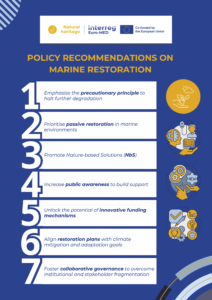
Policy recommendations on restoration – marine and coastal ecosystems
- Policy recommendations on restoration – marine and coastal ecosystems
Let’s build a fairer future together: endorse our policy recommendations on restoration by filling out the form.
- Natural Heritage Mission Feedback to the Nature Restoration Regulation Uniform Format
Policy recommendations on restoration – terrestrial and freshwater ecosystems
The policy brief, entitled “Mediterranean Ecosystems Restoration: Safeguarding Natural Heritage for People and Nature” lays out why we need to restore and protect the natural environment across the Mediterranean region, with a particular focus on forests and wetlands, which are currently threatened by climate change and human activity. The document emphasises that successful environmental recovery depends on key aspects such as inclusive governance, advocacy for the active participation of women, youth, and local communities in decision-making processes.
Policy recommendations on restoration – terrestrial and freshwater ecosystems
The document highlights various territorial solutions from concrete projects, including innovative methodologies like “Climagine” for coastal planning and “Democracy Labs” to foster public trust. Furthermore, it explores economic and digital tools, such as nature credits and geospatial monitoring platforms, to ensure that restoration efforts are both financially viable and based on accurate data. To sustain these initiatives, the document recommends strengthening capacity building through shared knowledge networks and educational activities like flash flood awareness games.
Ultimately, it serves as a strategic roadmap for aligning regional policies with international biodiversity goals to ensure long-term ecological and social resilience.
Institutional Dialogue
 The Natural Heritage Mission seeks to establish an ongoing and direct dialogue on policies that integrate technical knowledge and innovative solutions into effective and transformative governance. This approach aims to foster collaboration, improve governance, and facilitate the transfer of best practices among stakeholders both within and beyond the Mediterranean community.
A cornerstone of this effort is the organisation of Annual Institutional Dialogue events, designed to create a platform for exchange and cooperation between policymakers, scientists, and civil society.
The first Institutional Dialogue event was held on 23–24 November 2023 in Piran, Slovenia. It marked the launch of discussions on embedding technical expertise into actionable policies, with a focus on the challenges and opportunities for natural heritage conservation. For key takeaways, see here.
The second Institutional Dialogue event took place on 28–29 November 2024 in Málaga, Spain. This event brought together more than 150 experts from 17 Mediterranean countries, aiming to advance collaborative efforts in ecosystem restoration. Discussions focused on aligning actions with the Global Biodiversity Framework and the EU Nature Restoration Law, reinforcing regional and international conservation targets. For key takeaways, see here.
The third Institutional Dialogue event was organised from 25-27 November, 2025 in Barcelona, Spain. Bringing together more than 120 participants from 13 Mediterranean countries, representing European and Mediterranean institutions, national and local administrations, research centres and city networks, the event provided a vital platform to explore actionable solutions for protecting and restoring terrestrial and freshwater ecosystems. For key takeaways, see here.
These events are vital for strengthening regional collaboration and ensuring that Mediterranean stakeholders are equipped to address the dual crises of biodiversity loss and climate change through informed and coordinated action.
Synergies and Advocacy Work
The Natural Heritage Mission establishes strategic synergies with relevant Euro-Mediterranean and non-Euro-Mediterranean networks, initiatives, programmes, and organisations. A special focus is placed on fostering connections between the two shores of the Mediterranean Sea to enhance coordination among key actors addressing common challenges.
In addition, the Mission undertakes advocacy and positioning activities to ensure that the results achieved by the programme, the Thematic Projects, and the Natural Heritage Mission are disseminated in the Mediterranean region and beyond.
Events
The Natural Heritage Mission has actively participated in and contributed to several events, emphasising its commitment to fostering dialogue and collaboration across the Mediterranean region. Key events include:
- Kick-off meeting of Dialogue for Tourism project, Athens, 2/03/2023
- Conference of Community for Living Areas, Tirana, 30/03/2023
- 4th meeting of the UfM Working Group on Environment and Climate Change, hybrid, 24/05/2023
- Congress for Nature Conservation in Catalonia, Berguedà, 2-4/10/2023
- INSULEUR’s Annual Forum: Impacts of Climate Change on the Economies of European Islands, Athens, 1/12/2023
- 23rd Conference of the Parties (COP23) to the Barcelona Convention, Slovenia, 4-8/12/2023
- MED Talks, online, 5/12/2023
- Natural Heritage Mission Launches Policy Dialogue with Working Groups, online, 26/04/2024
- 2nd Online Working Groups Meeting – Restoration in the Mediterranean Region within the EU Nature Restoration Law, online, 8/10/2024.
- Natural Heritage Mission Highlights Contributions at the 8th Mediterranean Forest Week in Barcelona, 7/11/2024, Barcelona, Spain
- MED Talks 2024: Fostering Dialogue Between Northern and Southern Shores, online, 16/12/2024
- 9th Union for the Mediterranean (UfM) Working Group on Environment, online, 29/01/2025
- United Nations Economic Commission for Europe (UNECE) Regional Forum on Sustainable Development, online, 3/04/2025
- 3rd ISE Community of Practice gathering, Sarajevo, Bosnia and Herzegovina, 2-4/04/2025
- Working Groups’ Webinar: Strengthening Legal Tools for Coastal Conservation, online, 22/05/2025
- 2025 United Nations Ocean Conference, Nice, France, 9-13/06/2025
- UfM Mediterranean Green Week, Brussels, 24-27/06/2025
- EMD In My Country workshop on “Governance solutions for Mediterranean Marine Protected Areas”, Athens, Greece, 3/07/2025
- Innovative Sustainable Economy (ISE) Mission and BlueMissionMed (BMM) webinar on Water Management, online, 8/07/2025
- MedCat Days and ‘EU Investments in Strategic Projects’ event, Barcelona, Spain, 9/07/2025
- 23rd European Week of Regions and Cities, Brussels, 14-15/10/2025