On 27 May 2026, the Interreg Euro-MED Natural Heritage Mission held its first thematic webinar of the year, dedicated to Water Challenges and Opportunities in the Mediterranean. The session brought together around 70 participants from across the Mission community to exchange perspectives on one of the most pressing and cross-cutting challenges affecting Mediterranean territories today.
Water at the centre of political agendas
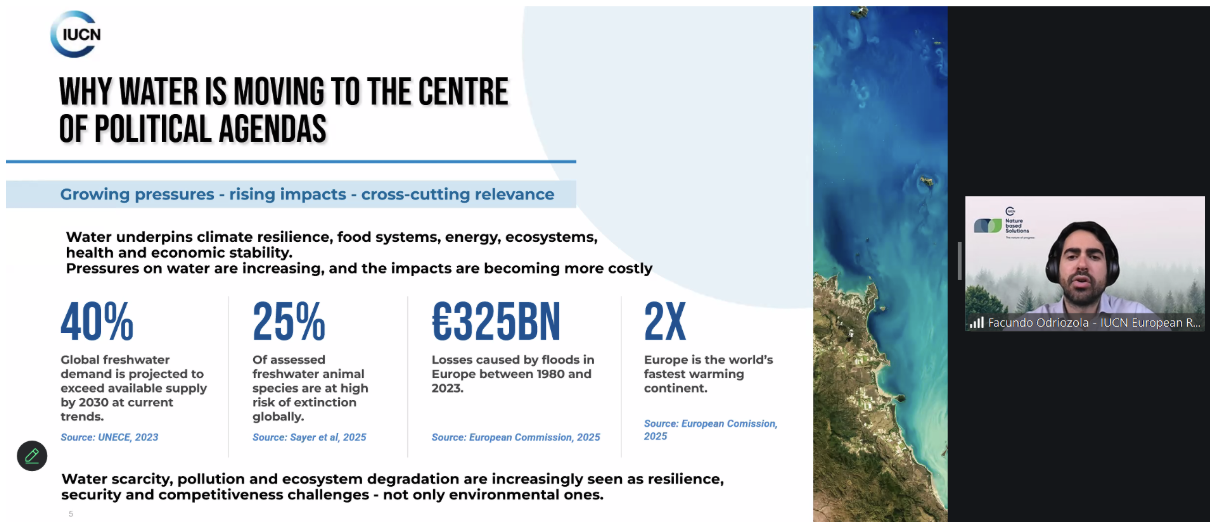
The webinar opened with a keynote presentation by Facundo Odriozola, Water and Agriculture Officer at the IUCN European Regional Office, who provided an overview of the evolving global and European water policy landscape.
His presentation highlighted how water is increasingly being recognised not only as an environmental issue, but also as a challenge directly linked to resilience, security, economic competitiveness, food systems, energy, biodiversity, and public health.
Several figures illustrated the growing urgency of the situation, including projections that global freshwater demand could exceed supply by 40% by 2030 under current trends, while freshwater biodiversity continues to decline rapidly.
Participants were introduced to some of the key global and European policy developments expected to shape the water agenda, including:
- The 2026 UN Water Conference, which aims to strengthen global coordination, accountability, financing, and implementation efforts around water governance.
- The European Water Resilience Strategy adopted in 2025, which promotes integrated approaches to water retention, ecosystem restoration, governance, innovation, and investment.
- The implementation and future evolution of the EU Water Framework Directive, particularly regarding implementation gaps, climate resilience, and the balance between flexibility and environmental protection.
While policy frameworks increasingly recognise the strategic importance of water, the main challenge remains implementation and translating commitments into measurable action on the ground.
Advancing the Mediterranean WEFE Nexus Strategy
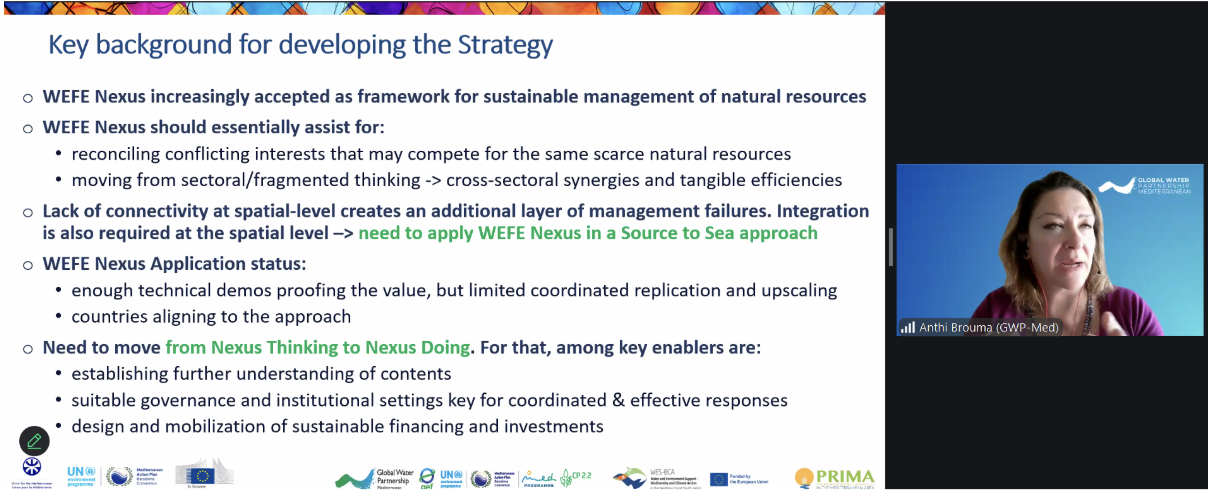
The second keynote session was delivered by Dr. Anthi Brouma, Deputy Regional Coordinator at the Global Water Partnership – Mediterranean (GWP-Med), who presented the Mediterranean Water-Energy-Food-Ecosystems (WEFE) Nexus Strategy and its emerging Action Framework.
The presentation explained how the WEFE Nexus approach seeks to move beyond fragmented sectoral management by promoting integrated governance and synergies between water, energy, food systems, and ecosystems.
Particular attention was given to the importance of applying this approach within a “source-to-sea” perspective, recognising the strong interconnections between inland territories, freshwater systems, coastal zones, and marine ecosystems across the Mediterranean basin.
Participants learned about the multi-stakeholder and political process that led to the adoption of the WEFE Nexus Strategy under the frameworks of the Union for the Mediterranean (UfM) and the Barcelona Convention. The strategy was officially approved in 2025 and is now recognised as a flagship initiative under the Mediterranean Strategy for Sustainable Development 2026–2035.
There is a need to move “from Nexus thinking to Nexus doing”, including through improved financing mechanisms, cross-sectoral coordination, knowledge sharing, and upscaling of successful territorial solutions.
Building the Natural Heritage Mission water advocacy roadmap
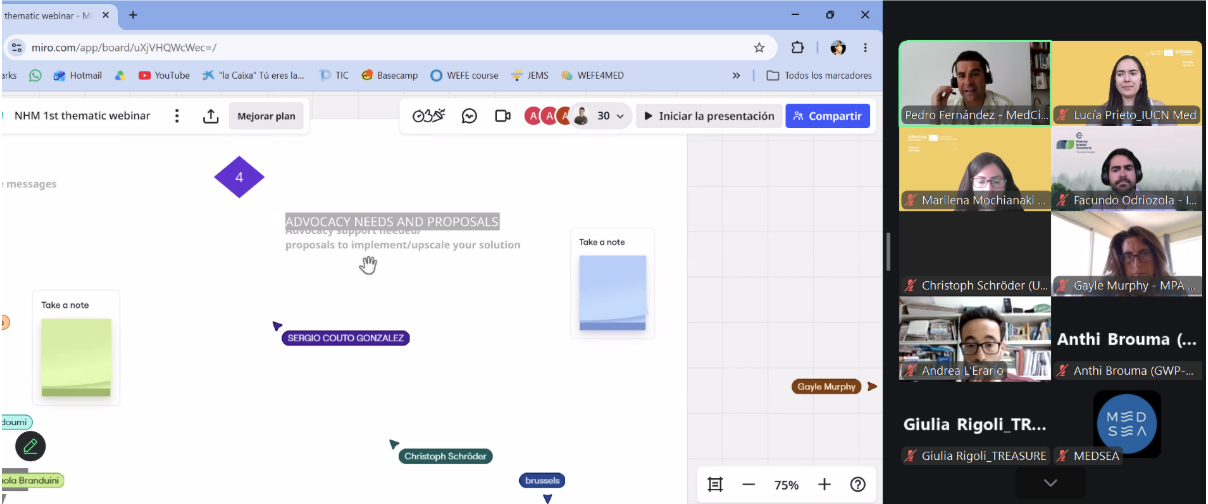
The second part of the webinar focused on the Natural Heritage Mission’s own advocacy plan for 2026-2029, and its specific roadmap on water for 2026. The roadmap aims to connect the experiences and solutions developed by thematic projects and territorial actors with upcoming Mediterranean and European policy processes.
The webinar concluded with an interactive Miro exercise where participants collaboratively linked territorial solutions and project experiences to themes, target groups, people-centered messages and advocacy needs.
This participatory process will continue throughout the year and contribute to the preparation of the Natural Heritage Mission’s water policy recommendations, which will be further refined during a second thematic webinar in autumn 2026.
All webinar materials, including the recording and keynote speakers’ presentations, are available here.